Bike lights do two jobs: help you see the road and help others see you. Commuters often ride in the dark or at dusk for part of the year, in traffic, with streetlights in some places and none in others. Good lights for commuting balance brightness, beam shape, runtime and reliability.
Check your local rules
Lighting requirements are set by states and cities. Many states require a white front light and a red rear reflector or light when riding at night. Some specify visibility distances. Check your state and local rules, and treat legal minimums as a starting point rather than a target.
Front lights
Lumens: what they tell you
Lumens describe the total light output a manufacturer claims. Higher numbers generally mean more light, but measurement methods vary between brands, and the highest figure is usually for a high-power mode with short runtime. Compare the lumen output for the mode you will actually use and the runtime in that mode.
| Riding conditions | Front light priorities |
|---|---|
| Well-lit city streets | Being seen: modest output, good side visibility, a daytime flash mode |
| Mixed suburban roads | Enough light to spot potholes; a shaped beam that does not dazzle drivers |
| Unlit roads and paths | Higher sustained output with a wide, even beam and long runtime |
Beam pattern
- Round “flashlight” beams throw light far but can dazzle oncoming riders and drivers if aimed too high.
- Shaped or cut-off beams put light on the road and limit glare above, similar to car headlights. These suit shared paths and roads with oncoming traffic.
Aim the light slightly down so the brightest part of the beam lands on the road ahead, not in other people’s eyes.
Side visibility
Many collisions involve vehicles approaching from the side at intersections. Lights with side cutouts or a wide lens are easier to see from angles other than straight ahead.
Rear lights
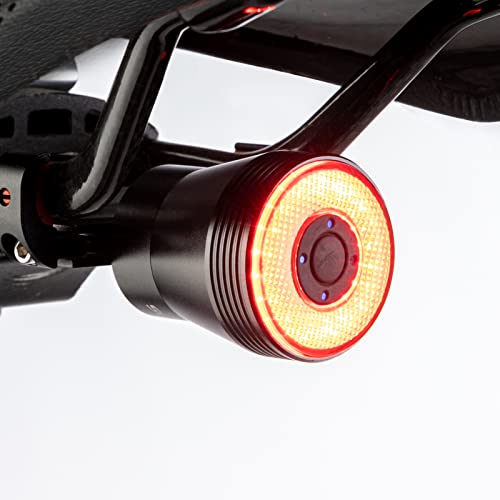
- Look for strong visibility from behind and from the sides.
- Flash modes can make you more noticeable; some riders use a steady mode on group rides or paths to avoid distracting others.
- Mount the light where bags or clothing will not block it.
- Some rear lights brighten automatically when slowing, using a built-in sensor. Treat this as an extra, not a replacement for good positioning.
Daytime running lights
Many commuters run a flashing front and rear light during the day to stand out in traffic. Some lights offer dedicated daytime modes designed for visibility in bright conditions.
Runtime and charging
- Check runtime for each mode, not just the maximum.
- Low-battery indicators help you avoid running out mid-ride.
- USB-rechargeable lights are convenient; check the charging port type and whether it has a weather-resistant cover.
- Some lights use replaceable batteries, which can be swapped on the road.
- Cold weather can reduce battery performance.
Mounts and security
- Check that the mount fits your handlebar diameter and shape and your seatpost profile (round, aero or D-shaped).
- Quick-release mounts make it easy to take lights with you when parking, which reduces theft.
- Helmet-mounted lights point where you look, which is useful on unlit paths. Many riders pair a helmet light with a handlebar light.
Weather resistance
Commuters ride in rain. Look for a water resistance rating, such as an IPX rating, published by the manufacturer, and check whether it applies with the charging port closed.
Who needs what
- City commuter on lit streets: a front light focused on being seen with good side visibility, a bright rear light and reflective details.
- Commuter on dark roads or paths: a higher-output front light with a shaped beam and long runtime, plus a rear light, and possibly a helmet light.
- Year-round commuter: consider two rear lights in case one runs out.
Frequently asked questions
How many lumens do I need for commuting?
It depends on how dark your route is. On lit streets, being seen matters more than lighting the road; on unlit routes, you need enough sustained light to see hazards at your speed. Compare lumens at the mode you will actually use, along with beam shape.
Should my lights flash or stay steady?
Flash modes can increase noticeability. Some local rules and group-ride etiquette favor steady lights in certain settings. Check your local rules.