Mountain biking after dark is not simply a daytime ride with a light attached. On a trail, you are often far from streetlights or any ambient glow, and the terrain changes constantly. According to REI’s bike light guidance, a light that only helps others see you is not enough for trail riding at night. You need a high-output system that lets you see the trail surface, obstacles, and upcoming turns clearly.
Handlebar Lights vs Helmet Lights: Why Many Riders Use Both
REI’s expert advice on bike lights explains that headlights can mount on your handlebar or your helmet, and for nighttime trail riding you should consider using both types. Each position solves a different problem, and relying on only one can leave you with a blind spot exactly when you need it most.
A handlebar light points wherever the bike points. A helmet-mounted light moves with your head: REI notes that its beam can be directed by just the turn of your head, making it the most versatile option if you are using only one light.
Understanding Lumens and Beam Patterns for Trail Riding
REI defines a lumen as a unit that quantifies the amount of light falling on the object you want illuminated, measured at a uniform distance. Most light manufacturers provide a lumen rating, and REI displays this on its product pages. For mountain bike night lights, REI categorizes high-output systems as those delivering 250 lumens and up. These rechargeable systems offer maximum illumination and help you see where you are going on the trail in nearly all conditions. Safety lights, which fall below 250 lumens, are designed to help motorists see you in dim light or daytime, but REI states they are not bright enough to help you see where you are going for most night riding.
Lumens alone do not tell the whole story. Beam pattern shapes how that light is distributed. On darker roads or trails, REI recommends a wide-focus beam for better peripheral vision. REI suggests a narrow-focus beam is an option for commuting on streets with streetlights. Beam patterns can be difficult for shoppers to compare, so REI suggests checking online product descriptions or asking a sales specialist for help.
Battery and Runtime: What Trail Riders Need to Know
Rechargeable lighting systems use lithium ion batteries that, according to REI, can be charged hundreds of times. This makes them an inexpensive and environmentally sound alternative to disposable batteries. Unlike alkalines that dim slowly over their life, most rechargeables deliver consistent light until their power is exhausted.
Because the light stays steady and then cuts off, most rechargeable lights include a fuel gauge or low-battery warning. REI advises that all rechargeables have a power light to indicate that power is available. Lithium ion batteries also suffer no memory effects from being fully discharged, so you can top them off without worry. However, REI cautions that inactive batteries lose their charge over time, so you should plug in and charge your system before every use. When charging, fully charge the batteries, especially before storage, but do not overcharge them. Most systems come with smart chargers that automatically stop when the batteries are full.
Most rechargeable units have multiple settings, letting you switch between long-lasting, low-power light and bright, high-intensity light that drains battery power more quickly. A flashing mode uses less battery power than a steady beam, but REI notes it is difficult to see well with a flashing headlight in the dark, so you should save flash mode for daytime use.
Mounts, Backup Lights, and Being Seen
Quick-release hardware lets you take your light with you when leaving your bike, especially when the battery and light are contained in a single unit. Battery packs for high-output lights can be attached to your bike or, since many have dramatically decreased in size and weight, stowed in a pack.
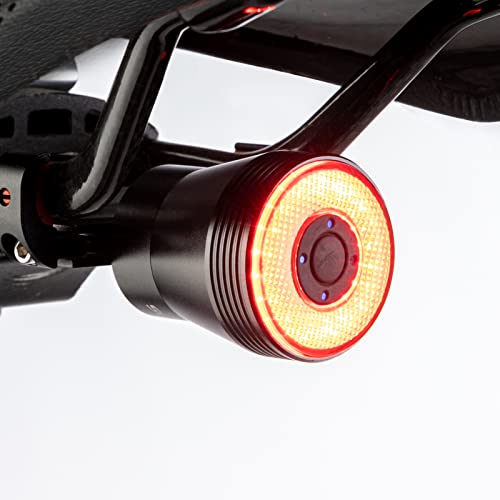
Even when your main goal is to see the trail, you still need to be seen by others. Rear safety lights can be mounted on your pack, pocket, or seatpost, and some can also mount on the back of rear bike racks. Side safety lights usually mount on spokes or frames, and REI points out that spoke-mounted lights are especially visible because they clearly show your wheels in motion.
Bike light laws, helmet requirements, and e-bike class rules vary by state and city. Before heading out, check your local regulations. For more on helmets that work well with lights, see our helmets guide and the mountain bike helmet guide.
Light Position Trade-Offs at a Glance
The table below summarizes the light types REI describes and where each mounts.
| Light type | Where it mounts (REI) | What REI says about it |
|---|---|---|
| Headlight | Handlebar; many can also mount on a helmet | For night trail riding, consider using both a handlebar and a helmet light |
| Helmet-mounted headlight | Helmet | Beam follows the turn of your head; the most versatile choice if you use only one light |
| Rear safety light | Pack, pocket, seatpost, or back of a rear rack | Helps others see you |
| Side safety light | Spokes or frame | Spoke-mounted lights are especially visible because they show your wheels in motion |
| Battery pack (high-output systems) | On the bike or stowed in a pack | Many have dramatically decreased in size and weight |
How to Care for Your Lights and Extend Their Life
REI states that most rechargeable batteries are capable of more than 500 charge/discharge cycles. Self-contained units can be charged via a power cord or USB charger. To keep your lights trail-ready, charge them fully before storage, but rely on the smart charger to prevent overcharging. Before every ride, plug the system in again, because batteries lose charge when sitting idle.
All lights sold by REI use durable housings sealed with weatherproof gaskets, so they are built to shine in any weather. For more on mounting hardware, read our bike light mounts guide.
For a broader look at gear that supports trail riding after dark, see our mountain bike gear checklist and the bike lights category page.
Frequently asked questions
Do I really need both a handlebar light and a helmet light for mountain biking at night?
REI’s bike light advice recommends considering both types for nighttime trail riding. A handlebar light gives you a steady beam on the path ahead, while a helmet light moves with your head and lets you see into turns and off-trail areas. If you are using only one light, REI says a helmet-mounted light is the most versatile, but pairing the two reduces blind spots on technical trails.
How many lumens do I need for trail riding in the dark?
REI categorizes high-output lighting systems as those delivering 250 lumens and up. These are rechargeable systems that offer maximum illumination and help you see where you are going on the trail in nearly all conditions. Lights below 250 lumens are considered safety lights and, according to REI, are not bright enough to help you see where you are going for most night riding.
Should I use a flashing mode on the trail at night?
REI notes that it is difficult to see well with a flashing headlight in the dark, so you should save the flash mode of your headlight for daytime use. A steady beam is better for illuminating the trail surface and obstacles. You can use a flashing mode on a rear safety light to help others see you without draining the battery as quickly.
Ready to explore more lighting options and mounts? Browse our full bike lights category.