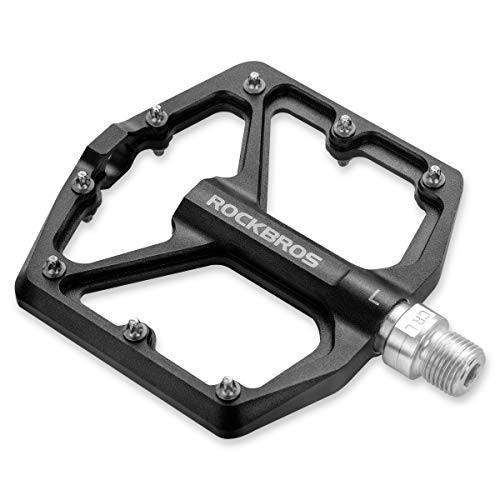
Flat pedals, often called platform pedals, are the simplest type of bicycle pedal. They have a wide, flat surface that supports your foot without any mechanical attachment. Riders who want to quickly take a foot off the pedal or walk comfortably in their shoes often choose this style.
What are flat pedals?
According to REI’s pedal guide, flat pedals provide a stable, wider surface to support your feet on both sides and can be used with nearly any shoe. They are not intended for use with clipless shoes. Park Tool’s overview of pedal retention systems notes that flat pedals have no retention options, meaning your feet are not mechanically locked to the pedal. Without a retention system, your feet can inadvertently fly off the pedal on rough terrain.
Why choose flat pedals?
REI’s expert advice explains that many downhill mountain bikers prefer flat pedals paired with a specifically designed shoe that has grippy soles or tread. This combination provides sufficient grip and control while being the easiest to get off of in the event of a crash. Platform pedals may also give you the confidence to help avoid a crash. Mountain bikers who want to freely take their foot off the pedals, aren’t as comfortable with clipless systems, or are just learning may also prefer the ease of platform pedals. Recreational cyclists, commuters, or riders who get on and off their bikes frequently often want flat pedals so they can wear more comfortable shoes that are easier to walk in. REI notes that clipless pedals take some practice to get in and out of, which is one reason newer riders often start on flats.
If you want some foot security without committing to a full clipless system, you can add toe clips to flat pedals. Park Tool’s guide to pedal retention systems describes toe clips as a simple, traditional method to help secure the feet. They attach to most platform pedals. A mini toe clip has minimal overlap and no strap, while a full toe clip with strap adds more security.
Flat pedals vs. clipless pedals
Choosing between flat and clipless pedals comes down to how you ride and what you value. The table below summarizes the key differences based on information from REI’s pedal and shoe guides and Park Tool’s retention system article.
| Feature | Flat Pedals | Clipless Pedals |
|---|---|---|
| Pedal type | Platform with no cleat mechanism | Spring-loaded mechanism that engages a cleat on the shoe |
| Shoe compatibility | Nearly any shoe; dedicated flat cycling shoes have grippy rubber outsoles for better traction | Requires cycling shoes with compatible 2-hole or 3-hole cleats |
| Foot retention | None; Park Tool notes feet can inadvertently fly off the pedal | Cleat engages the pedal; you release by twisting your heel outward (REI) |
| Pedaling and control | Foot is not held in place; it can come off the pedal on rough ground | REI says you transfer power when you pull up and push down; Park Tool calls full-circle pulling a common myth but agrees retention keeps the foot secure during the power stroke |
| Ease of walking | Shoes are comfortable to walk in; no cleats to interfere | Road shoes have protruding cleats that make walking difficult; mountain shoes have recessed cleats for easier walking |
| Typical use | Downhill mountain biking, recreational riding, commuting, frequent stops | Road cycling, cross-country mountain biking, performance riding |
For a deeper dive into the trade-offs, see our clipless vs. flat pedals comparison.
Installing and caring for flat pedals
Installing flat pedals follows the same thread directions as any bicycle pedal. Park Tool’s PW-3 pedal wrench instructions state that a pedal wrench is necessary for removing and installing pedals. The PW-3 is thin enough to fit the wrench flats of any pedal and has a long handle for leverage. Before installation, apply grease to the threads of both pedals. The right pedal (marked “R”) threads clockwise into the right crank arm, while the left pedal (marked “L”) threads counter-clockwise into the left crank arm. Tighten with the pedal wrench. To remove pedals, turn the right pedal counter-clockwise and the left pedal clockwise. Shifting the chain onto the largest chainring before removal helps protect your hands from sharp teeth.
For routine care, REI’s pedal maintenance advice recommends first looking for obvious signs of damage. If none are found, scrub the pedals with warm water to remove mud or debris, then let them dry. An old toothbrush makes an excellent cleaning tool, as REI suggests. While that guidance was written for clipless pedals, the same cleaning method works for flat pedals to keep the platform free of buildup. If you need a pedal wrench or other tools, browse our repair and maintenance gear.
Shoes for flat pedals
Flat pedals work with almost any shoe, but dedicated flat cycling shoes can improve grip and control. REI’s bike shoe guide describes flat (platform) mountain bike shoes as having no cleats and grippy rubber outsoles designed to “stick” to the pedals. Because you don’t clip in or out, it’s easy to step on and off the bike, which is convenient on trails. These shoes are a good choice for casual riding, trail riding, or more technical riding. City cycling shoes that resemble sneakers can also be used with flat pedals if they have a flat sole. For commuters, the ability to wear regular shoes off the bike is a major advantage. For more details, see our mountain bike shoes guide.
When riding on public roads, remember that bike light and helmet laws vary by state and city, so check local regulations. For commuters building a setup, our commuter cycling gear guide covers lights, locks, and apparel.
Frequently asked questions
Can I use flat pedals for road cycling?
Yes, you can. REI’s pedal guide notes that recreational cyclists and commuters often choose flat pedals for the convenience of wearing regular shoes. REI suggests clipless pedals if you want more efficiency and control, so many road riders use them; flat pedals suit riders who want to take their feet off quickly and walk easily.
Do flat pedals require special shoes?
No, flat pedals work with nearly any shoe. However, REI’s shoe guide explains that flat-specific mountain bike shoes have grippy rubber outsoles that provide better traction and help your feet stay planted on the pedals, especially on rough terrain.
How do I keep my feet from slipping off flat pedals?
Using shoes with a sticky rubber sole improves grip. REI’s advice for downhill mountain bikers highlights that pairing flat pedals with a shoe that has a grippy tread or sole provides sufficient control. Additionally, keeping the pedal surface clean and free of mud helps maintain traction.
Ready to explore your options? Visit our shoes and pedals category for more guides and gear information.