 By Logan Fleming
Smith prescription cycling glasses give you sharp vision and eye protection in one frame, but getting a good result depends on picking the right prescription method, lens tint and fit. This guide walks you through each decision, from checking your prescription to testing the fit on the bike, so you end up with a pair you can ride in comfortably for hours.
Understand Your Prescription Options Before You Buy
Not every Smith frame accepts the same kind of prescription. Most riders end up in one of two groups: those who need a full prescription lens made from their optician’s measurements, and those who use a clip-in or insert system that fits behind a standard sport lens. Knowing which path suits you saves a lot of back-and-forth later.
Shopping for one? See our guide: 7 Best Cycling Glasses with Prescription for Road Riders (2026).
If you want a deeper comparison of these two approaches, read Prescription Sports Glasses Cycling vs Clip-On Inserts: Which Should You Choose? before you commit. It covers the trade-offs in optical quality, weight and cost of replacement lenses.
Full Prescription Lenses
Full Rx lenses are ground to your exact prescription and set into the frame. The main advantage is optical clarity across the entire lens, with no seam or insert edge in your line of sight. The downside is that you are locked into the frame and lens combination you order, so changing tint or frame later usually means a new order.
Rx Inserts
Rx inserts are thin prescription lenses that sit behind the main sport lens, held by magnets or a clip. They are useful if you want to swap between tints for daytime, low light or night riding while keeping the same prescription. The trade-off is a slightly smaller field of view and the need to keep the insert clean and aligned. For a step-by-step on this setup, see Prescription Insert Cycling Glasses: How to Get Them Right.
Step 1: Get Your Prescription Details Right
Whichever route you take, the optician needs accurate numbers. Ask for a copy of your most recent prescription and check that it includes every value below.
- Sphere (SPH): the main power, shown as a plus or minus number in diopters.
- Cylinder (CYL) and axis: needed if you have astigmatism. The axis is a number from 1 to 180 degrees.
- Add power: only if you wear multifocal or reading correction.
- Pupillary distance (PD): the distance between your pupils in millimeters. Single-vision PD is usually enough for a sport frame, but ask for both distance and near PD if you use bifocals.
- Frame measurements: the lens width, bridge and temple length printed inside the Smith frame arm.
If your prescription is more than a few years old, get it re-checked. Vision changes gradually, and a lens that was right in an old exam may leave you squinting on long descents. Eye health concerns should be reviewed by an eye care professional.
Step 2: Choose a Frame Size That Fits Your Face
Smith sizes its cycling frames as small, medium or large in many models, and the fit affects both comfort and optical alignment. Prescription lenses depend on your eyes sitting close to the lens center, so a poor fit can cause blur at the edges.
| Check | What to look for | Why it matters |
|---|---|---|
| Lens center | Your pupils should sit near the optical center of each lens | Off-center pupils cause prism effects and eye strain |
| Bridge fit | The nose pads should rest without pinching or sliding | Slipping frames force you to tilt your head to see clearly |
| Temple length | Arms should sit behind the ear without pressure | Tight arms cause headaches on long rides |
| Coverage | Lenses should cover the eye area with a little room above the brow | Good coverage limits wind, dust and glare |
Measure your PD and compare it to the frame’s lens width. Many riders find their best fit by trying on frames in a shop before ordering, then transferring those measurements to the online order.
Step 3: Pick the Right Lens Tint and Coating
The lens tint controls how much light reaches your eyes and how contrast looks on the road. A prescription pair with the wrong tint can feel dim in the evening or too bright at midday.
- Daytime riding: mid-range gray or brown tints reduce glare while keeping colors natural.
- Variable light: photochromic or light-adaptive lenses darken in sun and lighten in shade. Check the activation range and whether the lens reaches a useful darkness in direct sun.
- Low light and dawn or dusk: yellow, amber or clear lenses increase contrast. Clear lenses suit night riding, though they offer no sun protection.
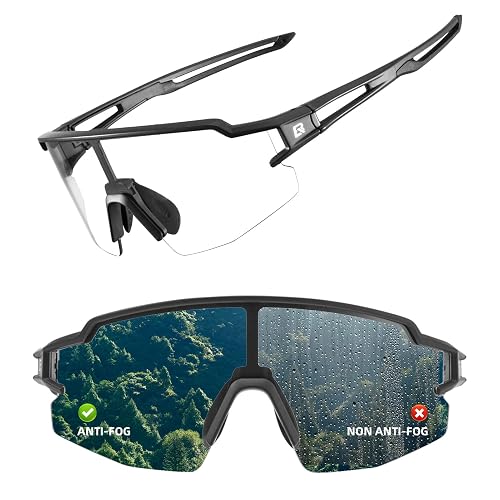
- Anti-fog: look for a factory anti-fog coating if you ride in cool, humid conditions, since fog can make a prescription lens nearly useless on climbs.
Lens coatings like scratch resistance and hydrophobic (water-repelling) treatments help keep the optics clean between rides. For a broader view of how tints map to conditions, the guide to 9 Best Photochromic Cycling Glasses for Changing Light (2026) shows how variable tints behave across the day.
Step 4: Plan the Ordering Process
Once you have your prescription, frame size and tint, follow a clear order process to avoid mistakes.
- Confirm the exact frame model and color code, including any “Rx-able” designation.
- Enter sphere, cylinder and axis values exactly as printed on your prescription. Double-check any minus signs.
- Enter your PD, or both distance and near PD if required.
- Select the lens material and index. Higher-index lenses are thinner and lighter, which helps with stronger prescriptions.
- Choose tint and coatings, then review the summary before paying.
- Keep your prescription copy for reference in case of questions from the lab.
Some retailers ask for a verification step, where they confirm the prescription with you by email. Respond promptly, since delays can push back delivery.
Step 5: Test the Fit and Optics Before Long Rides
When the glasses arrive, do a short test before a hard session. Put them on in a quiet spot and look at a straight line, such as a door frame or a building edge. Move your head slightly. Lines should stay straight and not bend or ripple.
Then ride a familiar loop at moderate effort. Pay attention to these points:
- Do the lenses slide when you look down at the handlebars?
- Does the field of view feel clear when you look ahead into the wind?
- Do you notice headaches or eye fatigue after 30 minutes?
- Does fog build up during climbs or in wet weather?
If something feels wrong, contact the lab or retailer early. Most Rx issues are fixable with adjustments, a remake or a PD correction, but they are harder to solve after months of use.
Common Mistakes to Avoid
- Using an old prescription: vision changes, and an outdated Rx can cause strain even with a well-made frame.
- Ignoring PD: a wrong PD is one of the most common reasons for blurred or uncomfortable lenses.
- Choosing a dark tint for night riding: dark lenses reduce the light you need after sunset and make hazards harder to see.
- Skipping the fit check: a frame that looks good may still slide, pinch or sit off-center.
- Cleaning with a shirt or paper towel: these can scratch coatings. Use a microfiber cloth and lens-safe cleaner.
- Forgetting a backup pair: if your only Rx glasses break mid-ride, you lose both vision and eye protection.
Tips for Long-Term Care and Performance
- Rinse grit off lenses with water before wiping, to avoid micro-scratches.
- Store glasses in a hard case when not in use, and never leave them on a dashboard or in direct heat.
- If you use inserts, check alignment each time you swap them and keep the magnets clean.
- Re-check your eyes every year or two, and update the prescription when your vision changes.
- Keep your frame’s lens order details saved so you can reorder the same specification later.
Recommended Gear
A few accessories make prescription cycling glasses easier to maintain and use. A reliable microfiber cloth prevents coating damage, while a spare case protects frames during travel. An anti-fog spray can help on cold, humid rides, and a compact lens cleaning kit keeps smudges off the road.
- Lens cleaning cloth: a soft microfiber option removes dust and oils without scratching coatings. View on Amazon
- Hard glasses case: protects frames and lenses in a bag or car. View on Amazon
- Anti-fog spray for lenses: helps reduce fogging on cool, humid rides. View on Amazon
FAQ
Can I get Smith prescription cycling glasses with my existing prescription?
Yes, as long as your prescription is current and includes sphere, cylinder and axis values if you have astigmatism. Your PD and frame measurements also need to be entered correctly.
What is the difference between Rx-able frames and Rx inserts?
Rx-able frames accept lenses ground to your prescription and set into the frame. Rx inserts are separate prescription lenses that sit behind the main sport lens, usually held by magnets or clips.
Do I need a separate pair for night riding?
Many riders prefer one pair with swappable tints or inserts, but a dedicated clear or yellow option often gives better contrast after dark. Choose based on how often you ride at night.
How do I know which PD to use?
Use the PD listed on your most recent prescription. If it shows only one number, that is usually the distance PD. An optician can measure it precisely if your paperwork is unclear.
Are photochromic lenses good for prescription cycling glasses?
They can be, especially for riders who move between sun and shade. Check how dark they get in sun and how quickly they clear, since some models are slower than others.
Why do my prescription glasses fog on climbs?
Breathing and sweat raise humidity behind the lens, and cool air can cause condensation. Anti-fog coatings, proper ventilation and a good frame fit all help reduce fogging.
How often should I update my prescription?
Most adults should have an eye exam every one to two years, though your eye care professional may recommend a different schedule. Update your glasses whenever your prescription changes.
What should I do if my new glasses feel wrong?
Contact the lab or retailer promptly and describe the symptoms. Headaches, blur or distortion can often be fixed with adjustments or a remake, but persistent problems should be reviewed by an eye care professional.
Conclusion
Getting smith prescription cycling glasses right comes down to accurate prescription data, a frame that fits your face, and a lens tint suited to how you ride. Take your time with the ordering steps and do a short fit test before your first long ride. With a careful setup, you get clear, comfortable vision and reliable eye protection on every route.
Related reading
- 7 Best Cycling Glasses with Rx Insert for Prescription Riders (2026)
- Safety Glasses for Cycling: How to Choose the Right Pair in 6 Steps
Ready to choose one?

About Logan Fleming
Logan puts together our cycling apparel & tech guides, digging through specifications, manufacturer details and owner reviews so you don't have to.





Write Your Review
No reviews yet. Be the first to share your experience!