
As an Amazon Associate I earn from qualifying purchases. This page may contain affiliate links.
A bike computer for mountain biking has a harder job than one built for the road. It has to hold a signal under tree cover, survive mud and drops, read clearly in bright sun, and still give you useful data like climb, descent and trail progress without constant menu digging. This list covers nine units across a range of budgets and feature sets, from simple wired speedometers to full-color GPS devices with preloaded trail maps. Each pick is judged on the criteria below: GPS quality and satellite support, screen readability, water and impact rating, battery life, mounting flexibility, and how well the navigation and ride-profile features suit off-road riding. Specifications come from manufacturer listings and common owner feedback patterns, not from our own lab testing.
Our Top Picks
Quick Comparison
| Product | Best for | Key feature |
|---|---|---|
| Garmin Edge MTB | Enduro and downhill riders who want maps and ride profiles | Enduro and downhill ride profiles with split tracking |
| iGPSPORT BSC500 | Riders who want turn-by-turn map navigation on a large touchscreen | 3.3-inch touchscreen with voice navigation |
| COOSPO CS600 | Riders wanting a touchscreen unit with radar support and long battery life | Color touchscreen with route navigation and bike radar support |
| GEOID CC700 Pro | Riders who plan routes and sync wirelessly to apps | Map navigation with re-route planning and WiFi auto-sync |
| CYCPLUS M1 | Riders who want a compact GPS unit with strong battery endurance | Long working time with Strava and FIT sync |
| CYCPLUS G1 | Riders who want a pocket-size GPS unit with professional data analysis | Compact body with extended working time |
| Wireless GPS Speedometer (2.4-inch, 50g) | Riders who want a light, simple GPS unit with altitude and gradient data | Lightweight body with altitude and gradient readouts |
| CATEYE Wired Bike Computer | Beginners and riders who want basic speed, distance and time | Simple wired setup with auto start and stop |
| Wired Bike Computer with Multi-Functions | Budget-minded riders who want a basic wired display | Multi-function LCD with automatic wake-up |
Garmin Edge MTB

Enduro & Downhill Ride Profiles, Automatically Track Split Times While Riding, Full-Color Preloaded Trail Maps Garmin Edge® MTB, Rugged GPS Bike Computer, Mountain Biking Metrics
This is the most trail-focused unit on the list. It suits enduro and downhill riders who want preloaded maps, structured ride profiles and split times on every descent.
Key specs
- Enduro and downhill ride profiles
- Automatic split time tracking while riding
- Full-color preloaded trail maps
- Rugged GPS housing
Pros If you want more background, see 8 Best Bike Lights for Mountain Biking: Trail-Ready Picks Compared.
- Ride profiles are built around how mountain bikers actually train and race.
- Split tracking makes it easy to compare runs on the same trail.
- Preloaded maps reduce the need for a phone on remote routes.
Cons
- Map and feature depth can mean a steeper learning curve for new riders.
- Owners sometimes report that the menus take practice to navigate with gloves on.
iGPSPORT BSC500

iGPSPORT BSC500 GPS Bike Computer, 3.3'' Touch Screen MAP Voice Navigation
This unit is a good match for riders who want a big touchscreen and map-based navigation without a phone in a mount. It works well for exploring unfamiliar trail networks.
Key specs
- 3.3-inch touchscreen
- Map display with voice navigation
- GPS bike computer format
Pros
- The large screen is easier to read at a glance than small monochrome displays.
- Voice navigation lets you keep your eyes on the trail.
- Touch input is quicker than button menus for route changes.
Cons
- Touchscreens can be less responsive when wet or with thick gloves, according to some owner reports.
- Larger units add more weight and bar space than minimalist computers.
COOSPO CS600

COOSPO Color Touchscreen GPS Bike Computer CS600, Wireless IPX7 Waterproof Cycling GPS Speedometer with Bluetooth/ANT+, Backlight Route Navigation, Support Bike Radar & 36H Battery Life
This touchscreen unit suits riders who want route navigation, radar integration and a battery that lasts through long days in the saddle.
Key specs
- Color touchscreen
- Wireless with Bluetooth and ANT+ connectivity
- IPX7 waterproof rating
- Bike radar support
- Backlit route navigation
- Battery life listed at up to 36 hours
Pros
- IPX7 rating gives strong protection against rain and washdowns.
- Radar support is useful for spotting approaching riders on shared trails.
- Long battery life suits multi-day or all-day rides.
Cons
- Brand recognition and app ecosystem are narrower than the largest brands.
- Some owners note the setup process takes a few extra steps.
GEOID CC700 Pro

GEOID CC700 Pro 2.8" Color Touchscreen GPS Bike/Cycling Computer, Map Navigation with Re-Route Planning, WiFi Auto-Sync, ANT+/Bluetooth, Message Notification, IPX7 Waterproof, Free Indoor Training
This unit fits riders who plan routes ahead of time and want wireless syncing to their phone or computer, with map navigation and re-routing on the trail.
Key specs
- 2.8-inch color touchscreen
- Map navigation with re-route planning
- WiFi auto-sync
- ANT+ and Bluetooth
- IPX7 waterproof rating
- Message notifications
Pros
- Re-routing helps when you take an unplanned turn or a trail is closed.
- WiFi sync removes much of the manual uploading after a ride.
- The IPX7 rating covers most trail conditions.
Cons
- Map features depend on proper route setup, which takes time for new users.
- Battery use increases noticeably when navigation and notifications are active.
CYCPLUS M1

4 Satellite Positioning, Bluetooth/ANT+, Auto Backlight Speedometer, >60 hours Working Time, Sync to CYCPLUS FIT and Strava CYCPLUS GPS Wireless Bike Computer M1, 2.9" LCD Screen, IPX6, 1200mAh
This compact GPS unit suits riders who care most about battery endurance and simple syncing to Strava or FIT-based platforms.
Key specs
- 2.9-inch LCD screen
- Four-satellite positioning
- Bluetooth and ANT+
- Auto backlight
- IPX6 water resistance
- 1200mAh battery, listed at over 60 hours
Pros
- Battery life listed at over 60 hours is well suited to long events.
- Strava and FIT sync is convenient for most riders.
- Auto backlight keeps the screen readable in changing light.
Cons
- IPX6 is a lower water rating than IPX7, so heavy washdowns call for care.
- The LCD is less detailed than color touchscreen models.
CYCPLUS G1
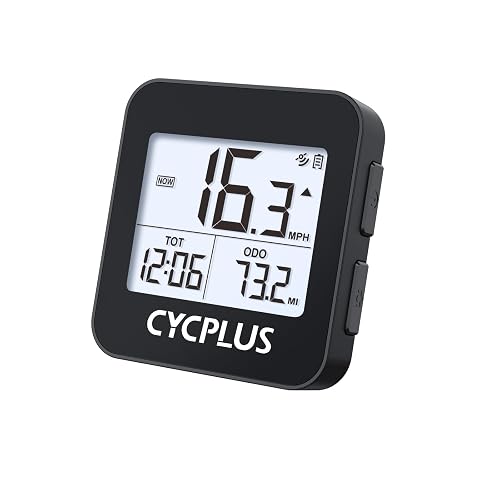
Pocket-Size, Bicycle Speedometer Odometer with Automatic Backlight, >55h Working Time, Provide Professional Data Analysis CYCPLUS Wireless GPS Bike Computer G1, 70g, 2.0" Screen, IPX6, 1200mAh
This pocket-sized GPS unit is aimed at riders who want a small, low-profile computer with solid battery life and data analysis.
Key specs
- 2.0-inch screen
- IPX6 water resistance
- 1200mAh battery
- Auto backlight
- Listed working time of over 55 hours
Pros
- Small body is easy to mount on a crowded cockpit.
- Battery endurance is strong for its size.
- Automatic backlight adjusts to changing light on forest trails.
Cons
- The 2.0-inch screen can be harder to read at speed than larger displays.
- Fewer map and navigation features than the touchscreen units above.
Wireless GPS Bike Computer 50g (2.4-inch)

Bicycle Speedometer Odometer, Green Auto Backlight, Auto Start Stop, MPH/KMH, Altitude and Gradient Data Wireless GPS Bike Computer, 50g, 2.4" Screen, IPX7, 28H Runtime
This lightweight unit suits weight-conscious riders who want GPS, altitude and gradient data with a simple layout.
Key specs
- 2.4-inch screen
- Weighs 50g
- IPX7 waterproof rating
- Altitude and gradient data
- MPH and KMH display
- Listed runtime of 28 hours
Pros
- At 50g, it adds very little weight to the bar.
- Altitude and gradient readouts are useful on climb-heavy trails.
- IPX7 rating matches the more expensive units on this list.
Cons
- A 28-hour runtime is shorter than some competitors, so plan charging for multi-day use.
- Owners sometimes mention that the brand and app support is less established.
CATEYE Wired Bike Computer

Entry-Level Speedometer and Odometer, Perfect for Beginner Cyclists, Auto Start/Stop, Easy Setup for Road, MTB, Gravel Bikes CATEYE Wired Bike Computer
This entry-level wired computer is a practical choice for beginners and for riders who want basic speed, distance and time without GPS.
Key specs
- Wired connection
- Auto start and stop
- Works on road, mountain and gravel bikes
- Simple setup
Pros
- Setup is straightforward, and no batteries in the sensor are needed on many wired systems.
- Auto start and stop keeps trip data accurate without manual input.
- Well-known brand with a long track record among cyclists.
Cons
- No GPS, navigation or route features.
- Wired cables need careful routing to avoid snags on rough trails.
Wired Bike Computer with Multi-Functions

Bike Computer and Bicycle Odometer Wired MPH KM/H Bike Speedometer with Automatic Wake-Up Cycling Speed Tracker LCD Display & Single Mileage & Multi-Functions Accessories
This budget wired unit suits riders who want a multi-function display and automatic wake-up without spending on GPS.
Key specs
- LCD display with single and multi-mileage modes
- Automatic wake-up
- MPH and KM/H units
- Wired connection
Pros
- Multi-function display covers speed, distance, time and more.
- Automatic wake-up means you rarely need to press buttons.
- Simple mounting for riders on a tight budget.
Cons
- No GPS, mapping or route features.
- Wired installation can be fiddly on suspension forks and dropper routing.
Buying Guide
Choosing a bike computer for mountain biking comes down to how you ride and where. A descender in a bike park has different needs from a rider doing all-day backcountry loops, and both differ from someone who just wants to know their speed on a local singletrack.
Selection Criteria
- GPS quality: Look for multi-band or multi-satellite support if you ride deep forest or canyon terrain, where signal drops are common.
- Screen readability: Bright sun and vibration both hurt legibility. Larger, higher-contrast screens are easier to read at speed.
- Water and impact rating: IPX7 covers immersion and heavy rain. IPX6 handles strong spray. Check the rating against how often you wash your bike.
- Battery life: A listed runtime of 20 to 30 hours is enough for most weekend rides. Multi-day or event riding calls for longer endurance.
- Mounting: Check the mount type against your handlebar diameter and whether you want a quick-release option. For mount ideas, see 8 Best Mountain Bike Computer Mounts for Trail Riders (2026).
Important Features
Trail-focused features matter more than road features on a mountain bike. Ride profiles, split times, altitude and gradient data, and preloaded or downloadable trail maps are useful when you ride the same loops repeatedly or need to navigate unfamiliar terrain. Radar support, which some touchscreen units offer, can help you spot riders coming up behind you on shared trails. For a broader look at how these compare, see Garmin Mountain Bike Computer Picks: 10 Best Options for Trail Riders (2026) and Mountain Bike Gear: A Checklist for Trail Riders.
Specs to Check
- Satellite and GNSS support
- Screen size, type and brightness
- IPX rating
- Battery runtime and charging method
- Connectivity: ANT+, Bluetooth, WiFi
- Mount compatibility and weight
- Sync platform: Strava, FIT or manufacturer app
Choosing by Need
- Enduro or downhill racing: Choose a unit with ride profiles and split tracking, such as the Garmin Edge MTB.
- Route navigation on unfamiliar trails: Touchscreen units with maps and re-routing, such as the iGPSPORT BSC500 or GEOID CC700 Pro, suit this.
- Long rides and endurance events: Prioritize battery life, such as the CYCPLUS M1 or COOSPO CS600.
- Minimal weight and bar clutter: Compact or lightweight units work well, as do the CYCPLUS G1 and the 50g wireless model.
- Simple speed and distance on a budget: Wired units are the practical choice.
Things to Watch Out For
- Trail maps and navigation features often need a subscription or a separate download. Check before you buy.
- Touchscreens can be harder to use with wet hands or thick gloves. Test the input method in cold conditions if possible.
- Wired systems require careful cable routing on bikes with dropper posts and suspension.
- Battery life listings are usually based on manufacturer test conditions. Real-world results vary with GPS use, screen brightness and temperature.
FAQ
Do I need GPS on a mountain bike computer?
GPS is useful if you ride unfamiliar trails, want route navigation or track your ride data on a map. If you mostly ride known loops and only need speed, distance and time, a wired computer or a basic sensor-based unit can be enough.
What IPX rating should I look for?
IPX7 covers temporary immersion, which suits riders who ride in heavy rain or wash their bike with a hose. IPX6 resists strong water jets and is adequate for most trail conditions. Neither rating means the unit is fully sealed against dust or long submersion.
How long should the battery last?
For most weekend rides, a listed runtime of 20 to 30 hours is comfortable. Longer endurance matters for multi-day trips or events. Remember that GPS use and bright screens reduce real-world runtime compared with the manufacturer’s figure.
Can I use a phone instead of a bike computer?
A phone works for navigation and tracking, but it is exposed to shock and water, drains quickly and is harder to read in sun. A dedicated unit is generally better for trail use. For a closer look at the trade-offs, see iPhone as Bike Computer vs Dedicated Unit: Which Should You Choose?.
Do I need a cadence or heart rate sensor?
Not necessarily. Many riders are satisfied with speed, distance, time and elevation. Cadence and heart rate become more useful if you train with structured goals. Check whether the computer supports ANT+ or Bluetooth sensors before buying.
What mounting option is best on a mountain bike?
Choose a mount that fits your handlebar diameter and clears your brake levers, dropper lever and light mount. Quick-release systems help if you move the computer between bikes. For more options, see Canyon Bike Computer Mount: How to Install and Choose the Right One.
Is a wired computer still a good option?
Yes, for riders who want simple, reliable speed and distance data without GPS or app syncing. Wired units tend to have fewer features but straightforward setup. They suit beginners and budget-focused riders.
Conclusion
There is no single best bike computer for mountain biking, because the right choice depends on terrain, ride style and how much data you want. For enduro and downhill riders who want trail maps and ride profiles, the Garmin Edge MTB is the most focused option on this list. Riders who want map navigation on a big screen should look at the iGPSPORT BSC500 or the GEOID CC700 Pro. The COOSPO CS600 and CYCPLUS M1 suit riders who value battery life and touchscreen navigation or Strava syncing. The CYCPLUS G1 and the 50g wireless unit work well for riders who want a compact, lightweight GPS computer. For simple speed and distance on a budget, the CATEYE Wired Bike Computer and the multi-function wired model are practical choices. Match the features to your riding, check the IPX rating and mount compatibility, and you will end up with a unit that fits your trails.





Write Your Review
No reviews yet. Be the first to share your experience!